
Panjeeri and Family Bonds: How One Recipe Connects Generations
- Desi Panjeeri Team

- Nov 3, 2025
- 4 min read
In every South Asian home, there’s a recipe that carries more than taste — it carries memory. The scent of roasting wheat flour, the crackle of ghee, the sweetness of crushed nuts — for many of us, that’s Panjeeri. It’s not just a traditional food; it’s a family story told in aroma, warmth, and care. A recipe that travels from one generation’s hands to another’s heart.
The First Taste of Home
For countless children, their first memory of Panjeeri isn’t from a fancy occasion — it’s from a quiet morning in their grandmother’s kitchen. The air thick with the nutty smell of roasted flour and the gentle hum of her voice. She’d scoop a handful into a bowl, still warm, and say, “Eat this — it’s good for your strength.”
Back then, it didn’t mean much. But as the years pass, we realise it wasn’t just nourishment. It was love disguised as food. It was her way of saying, “I care for you,” in the language she knew best.
Every family has that one recipe — the one you can’t quite replicate, even if you follow every step. For many, Panjeeri is that recipe. You can try to make it the same way, but something about the touch, the patience, and the stories told while stirring makes it unique.
A Recipe Written in Memory, Not on Paper
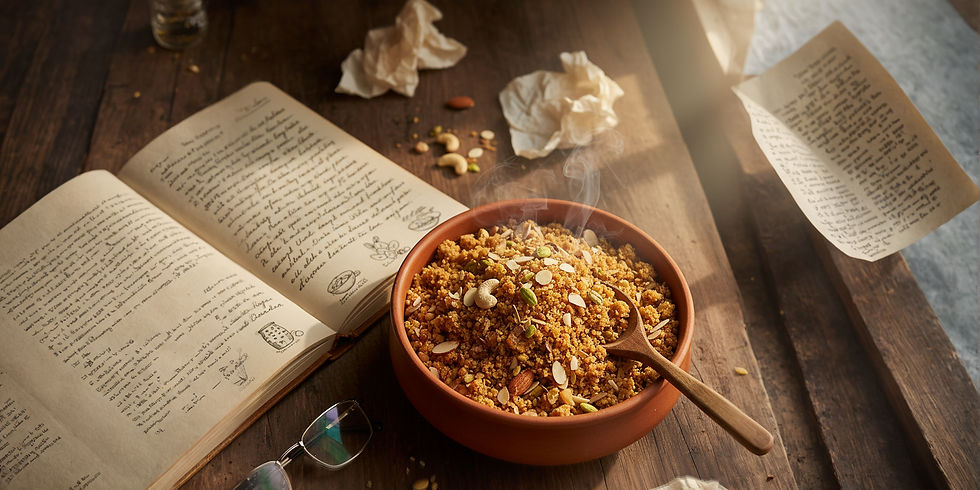
What’s fascinating about Panjeeri is how rarely it’s written down. Most of us learn it by watching, not reading. Our grandmothers never measured; they “just knew.” A handful of this, a pinch of that — it’s intuition shaped by generations of practice.
When you ask for the recipe, you don’t get a list — you get a story. “When your mother was born, I added more almonds,” “Your grandfather liked it sweeter,” “I used to make this when your father went to school.” Each version of Panjeeri holds the fingerprints of the family it came from.
That’s how tradition survives — not through perfect replication, but through loving reinterpretation. Every time a new generation stirs the pan, they add a little of themselves to the recipe.
Connecting Generations Across Distance
For those living abroad, away from home, the smell of Panjeeri can be emotional. It’s the scent of belonging. Making it in a small apartment in Budapest or London is more than cooking — it’s summoning home into the room.
When you roast the flour and hear the hiss of ghee hitting the pan, you can almost hear your mother’s voice, telling you not to let it burn. You remember your grandmother’s gold bangles clinking as she stirred. You remember the way everyone gathered to taste it before it cooled.
In a world where everything changes so quickly — languages, cities, lifestyles — recipes like Panjeeri anchor us. They remind us of where we come from, of the people who made us who we are. It’s a taste of continuity in a world of constant change.
A Symbol of Care and Connection
Traditionally, Panjeeri was made for new mothers to regain strength after childbirth. But even beyond that purpose, it’s always been a food of care. You make it for someone you love — to nourish, comfort, and strengthen them.
In many ways, making Panjeeri is an act of service. It takes time, patience, and attention — you can’t rush it. Each ingredient has to be roasted perfectly, each nut chopped with care. And that’s what makes it special. It reflects the slow, mindful love that defines family bonds — the kind that can’t be rushed or replaced.
In every spoonful, there’s history. Wheat roasted by hands that once held your own. Sugar stirred by someone who knew your childhood laughter. It’s not just food — it’s a keepsake of affection.
Passing It On
As younger generations grow up in new countries, many of us try to hold on to these traditions in modern ways. We record our mothers making Panjeeri on our phones, we write the recipe down for the first time, or we gift jars of it to friends who’ve never tasted it before.
Each of these small acts keeps the legacy alive. Because family traditions don’t disappear in a single generation — they fade only if we stop sharing them. And Panjeeri, with its humble ingredients and heartfelt purpose, is the perfect reminder that culture is not something we inherit; it’s something we continue.
So when you next make Panjeeri — maybe in a different kitchen, maybe with slightly different ingredients — remember that you’re not just following a recipe. You’re continuing a story. You’re blending memory with modernity, keeping a thread of home alive through something as simple as food.

The Taste of Timeless Love
When families gather — during festivals, weddings, or just ordinary days — Panjeeri often makes an appearance. Not because it’s luxurious, but because it’s familiar. It brings comfort and conversation. Someone always says, “This tastes just like nani’s,” and suddenly everyone smiles.
That’s the magic of food that holds memories — it shortens distance and softens time. Even when generations live apart, one taste can make them feel together again.
Panjeeri teaches us that recipes aren’t just for eating; they’re for remembering. And in remembering, we find connection — to our roots, our families, and to the love that quietly passes from one generation to the next.
Disclaimer:
Panjeeri is a traditional South Asian food believed to offer nourishment and strength. Its benefits are based on cultural practices, not scientific evidence.


Comments